Influencer Marketing Terms and Definitions


In an industry filled with jargon and buzzwords, the influence landscape can be difficult to navigate. This problem is confounded when terms are used interchangeably, or even, incorrectly. On the flip side, having a solid foundation of “what’s what” will help you master this worthwhile craft.
This living* glossary will help you understand industry terms from influencer identification, to social commerce, to influencer vetting, these terms and definitions span all aspects of the practice.
* This glossary of definitions will be regularly updated.
The Basics: Must-Know Influencer Marketing Definitions
Influence
The ability to cause measurable effect or change impressions or behaviors.
Defined By: Brian Solis
Resources: Exploring and Defining Influence, A Framework for Influencer Marketing
Influencer
A person or group of people who possess greater than average advantage potential to influence due to attributions such as frequency of communication, personal persuasiveness or size of and centrality to a social network.
Defined By: WOMMA
Resources: Influencer Guidebook Slideshare, A Framework for Influencer Marketing
Influencer Marketing
A marketing strategy that focuses on partnering with an individual with influence to amplify your brand’s message. Instead of paying for ads to get in front of buyers, brands collaborate with influencers who already have trust and rapport with your desired audience.
Defined By: Rachel Miller
Resources: Rachel Miller’s Influencer Marketing Definition, Guide to Influencer Marketing, AIM: Setting Sail with IM, What is Influencer Marketing?
Influencer Relations
The art of building a partnership between your brand and independent industry experts, based on shared goals, common values, and uncompromised authenticity.
Defined By: Konstanze Alex-Brown
Resources: Influencer Marketing 2.0: The Future of Influencer Marketing
Influencer Engagement
A function of a relationship-based approach to working with influencers where brands interact based on knowledge of the influencer's interests and goals. Ongoing engagement can take many forms from social sharing and commenting to content co-creation to program collaboration. A transactional approach to interacting with influencers is technically a form of engagement, but it is the lowest form in terms of mutual value.
Defined By: Lee Odden
Resources: The Marketer’s Guide to Mastering Influencer Engagement
Influencer Outreach
The process of initially attempting to form a relationship with an influencer. Successful influencer outreach sits at that sweet spot of understanding what makes your business tick, what makes a desired influencer tick, and showing the latter why engaging with the former would benefit him/her. It opens the door for future engagement; more eHarmony than Tinder.
Defined By: Shonali Burke
Resources: The Three R’s of Influencer Outreach, Step-By-Step Guide to Influencer Outreach
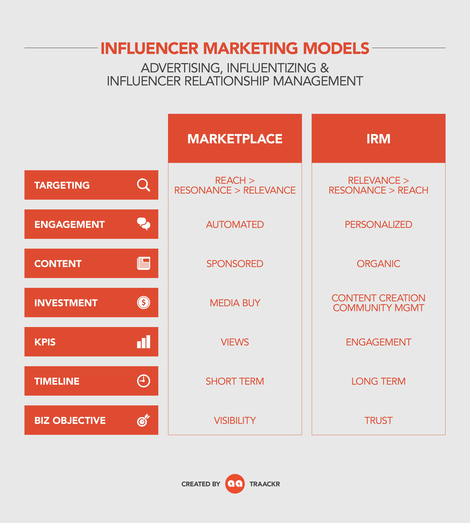
Influencer Marketplace
A technology that aims to match brands and participating influencers based on simple criteria, facilitate fulfillment of paid activities through standardized processes and provide KPIs that attempt to mimic advertising performance measures.
Defined By: Nicolas Chabot
Synonyms: Opt-In Network, Pay-to-Play, Influentizing
Resources: Two different paths to influencer marketing, Opt-out of Opt-In Network
Influencer Advertising
The discipline of leveraging influencer content as an extension of marketing’s paid digital media practice, often confused with influencer marketing. Influencer advertising consists of buying influencer content as media directly from influencers or through influencer marketplaces. Government regulations often require strict disclosure to consumers of sponsored influencer content by adding the mention #ad or #sponsored to such content.
Resources: 5 Most Dangerous Myths of IM
Influencer Compensation
The method by which an influencer is paid for their time, expertise or partnership with a brand. Although some compensation is monetary, compensation can also include offering the influencer experiences, trips, or free product. Influencer compensation should be relational, not transactional.
Resources: Hot Take: Why You Should Pay Your Influencers, CMO Insights: 5 Key Ways to Identify the Right Influencers
Influencer Content Co-Creation
The process of a brand partnering with an influencer, or group of influencers, to produce a piece of content. In this scenario, both the brand and the influencer impact the creative process and co-promote the content together.
Resources: Guide to Content Marketing & Influencer Strategy, IM Content Framework
Influencer-Generated Content (IGC)
A piece of content an influencer creates that mentions a brand. In co-creation, the content is created in partnership with the brand but with IGC, the influencer has more creative freedom and leverages their authentic voice to engage with their audience. Similar to user-generated content (UGC), IGC is authentic content created by a person mentioning the brand’s products or services.
Influencer Selection & Identification Keywords Defined
Influencer Identification
The ability to map business goals downward to the people who can help your brand achieve them. Selecting influencers to partner with means looking for trust and authenticity with the desired audience you are trying to reach. The key element of picking influencers to work with is starting with a success in mind and selecting influencers who can help your brand achieve that success.
Defined By: Brian Fanzo
Resources: Guide to Influencer Identification
Influencer Vetting
Influencer vetting is the process of evaluating influencers based on performance, audience quality and value alignment.
In order to partner with influencers who align with your brand values and avoid influencer fraud, influencer marketers usually use an influencer marketing platform to automate brand safety checks, assess audience authenticity, and establish approval workflows.
Resources: Learn more about brand safety
Influencer Tiers
An influencer tier refers to the number of followers an influencer has. Partnering with influencers in different tiers can be useful for different campaigns. VIPs can be great for large scale launches where you want to get the word out to as many people as possible. Mid tier influencers can be a sweet spot where you can cultivate a partnership with them in a longer lasting relationship. Smaller audiences can be great for product seeding and influencers in these tiers often have very high engagement rates.
How many followers are in these different influencer tiers?
VIP: 5M+
Top: 1M+
Macro: 500K+
Mid: 50K+
Micro: 10K+
Nano: 1K+
Resources: 3 Future Proofing Influencer Strategies: Advice from a CMO
Reach
A measure of an influencer’s audience size. Aside from possessing qualities that have the power to drive action, an influencer has an above-average number of followers in a specific niche or market.
Defined By: Brian Solis
Resources: 3 R’s of Influence
Resonance
Resonance refers to how much an influencer’s audience cares about the content they create - this is usually associated with stats such as engagement rate.
Resources: 3 R’s of Influence
Relevance
A measure of how relevant an influencer is to a topic that is relevant to your brand. Look for mutual relevance. Find this by assessing keywords the influencers are showing up for when you do Google searches, as well as tags and categories on their blog, hashtags they are using on Twitter and Facebook, and the topics of groups they are involved in.
Defined By: Brian Solis
Resources: 3 R’s of Influence
Influencer Profile
A model example of key characteristics a type of influencer would possess. Brands should establish influencer profiles to categorize the types of influencers they want to work with. These characteristics might include the size of following, current relationship status with the brand, the type of content they create, and how they like to be engaged.
Try to be creative with how you identify influencers, and don't get too stuck on a certain profile. Some of the best partnerships come from unexpected places. Like the beauty industry's partnerships with live gaming streamers.
Resources: Many Faces of Influence eBook, Revlon x Wonder Woman 1984 Case Study
Influencer Marketing Measurement Definitions
Brand Mentions
The number of times an influencer mentions a brand in their content. Mentions can be organic or paid.
Resources: Travelocity Case Study
Impressions
The number of views that a specific post or piece of content received over a specific period of time.This measurement is often used to calculate Cost Per Impression (CPI).
Resources: A Framework for Measuring IM Success
Share-of-Voice
The percentage or portion of the conversation with target consumers or influencers your brand owns versus your competitors. This conversation can be across social media, blogs, or any other place your target audience hears from brands.
Defined By: TrackMaven
Resources: A Framework for Measuring IM Success
Social Commerce
Social commerce is a rising subset of e-commerce that is enabled by social media, and often facilitated by influencers. Instagram, TikTok, Facebook, Snapchat, Twitter and Pinterest are all racing to offer top tools to aid social commerce - including augmented reality, live shopping abilities, direct social shopping experiences, influencer marketplaces and creator tools.
Resources: Traackr's Social Commerce Tools, How to Build Social Commerce into Your Influencer Program
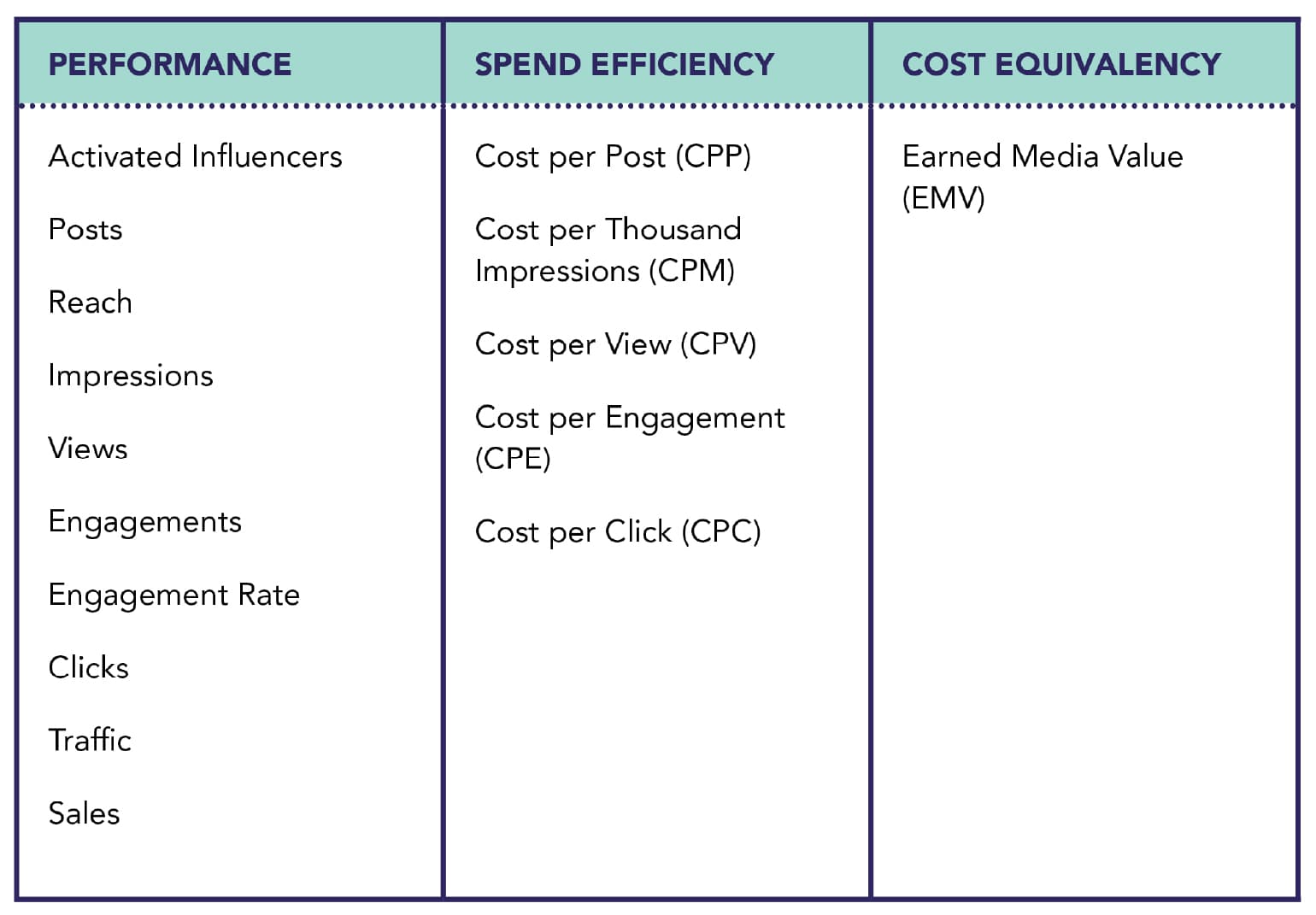
Performance Metrics
Measure the impact of influencer marketing
In addition to measuring impact against specific objectives, unified Performance Metrics can be very useful in evaluating the impact of influencer marketing in a more holistic way. Last year, Traackr introduced our Brand Vitality Score (VIT) which incorporates Visibility, Impact, and Trust to provide a comprehensive view of influencer marketing performance across the customer journey.
Resource: Playbook: How Market Leaders Measure Influencer Marketing
Spend Efficiency Metrics
Measure the efficiency of influencer marketing investments.
These metrics enable you to understand which influencers and strategies are delivering the most bang for your buck and, in turn, can act as levers for improving your return-on-investment (ROI) going forward.
Spend efficiency metric examples: Cost per post (CPP), Cost per view (CPV), Cost per engagement (CPE), Cost per click (CPC)
Resources: Optimize Influencer Investments with Data-Driven Influencer Marketing Software
Cost Equivalency Metrics
Measure the efficacy of influencer marketing investments as compared to other marketing disciplines.
Earned Media Value (EMV) is a notorious metric in the world of influencer marketing, for several reasons. Chief among them, it has been misused as a Performance Metric.
In reality, EMV is a Cost Equivalency Metric for measuring the efficacy of influencer marketing investments as compared to other marketing disciplines, such as digital advertising.
At Traackr, we use VIT. The Brand Vitality Score (VIT) is the first metric uniquely created for measuring a brand’s performance in influencers’ content. It was designed to measure what matters—visibility (reach of content), impact (engagement generated) and brand trust (quality of content on brand image).
Resources: What is VIT and how is it used?
Influencer Relationship Management
Influencer Relationship Management (IRM)
The process of building and managing long-term relationships with a select group of influencers. Often described as ‘CRM for Marketers’. IRM programs aim to increase the positive mentions of your brand among select opinion leaders, driving brand visibility and advocacy. Successful IRM programs build always-on, collaborative partnerships with key influencers and facilitate the co-creation of content.
Link: Traackr's IRM Platform, From CRM to IRM: The Rise of Social Influence
Relationship Ladder
A convention to define a brand’s relationship with an influencer. All influencers begin in “unaware” and climb the ladder to eventually become an “advocate”. Just like any relationship, it has ebbs and flows. Meaning, that once an influencer reaches one step, it's not always a given that they will naturally move up to the next step. You might take one step quickly, and then take twice as long to reach the next step. Other times, you might reach the top of the ladder only to fall back a step. Like any relationship, it takes work to stay on top.
Defined By: Amy Higgins
Links: Traackr’s Relationship Funnel
Brand Advocate
A person who has a genuine affinity towards a brand and actively endorses or promotes the brand to their network both online and offline, organically. Advocates are not always influencers. Some brand advocates will have a large social following and authority in the space, while others will not. Advocates authentically believe in the brand’s products or services and recommend them to their network.
Links: 8 Ways to Turn Your Influencers Into True Brand Advocates
Always-On
For influencer marketing programs, an always-on strategy is the best approach. The process of a brand continuously engaging with their influencers to build long-term relationships and programs that are mutually beneficial. Rather than only engaging influencers for a campaign or event, this method is intended to increase engagement with influencers by continuing to build content, amplification at events and marketing campaigns/offers year round.
Resources: How Eau Thermale Avène used an “always-on” influencer strategy, The Marketer’s Guide to Mastering Influencer Engagement
Listen to Bella Clark, Head of Influencer and Partnerships at Lipton, and content creator, Thuy Le, share why authenticity outshines extravagance when it comes to creator partnerships.
Listen nowSee which brands are leading the way in influencer marketing with our real-time performance leaderboard.
View brand leaderboard%201.jpg)
.jpg)
%20(1).jpg)
.jpg)
Level up your creator marketing expertise
Get industry insights and updates straight to your inbox.